
A paradigm shift from Smart Store to Agentic Store
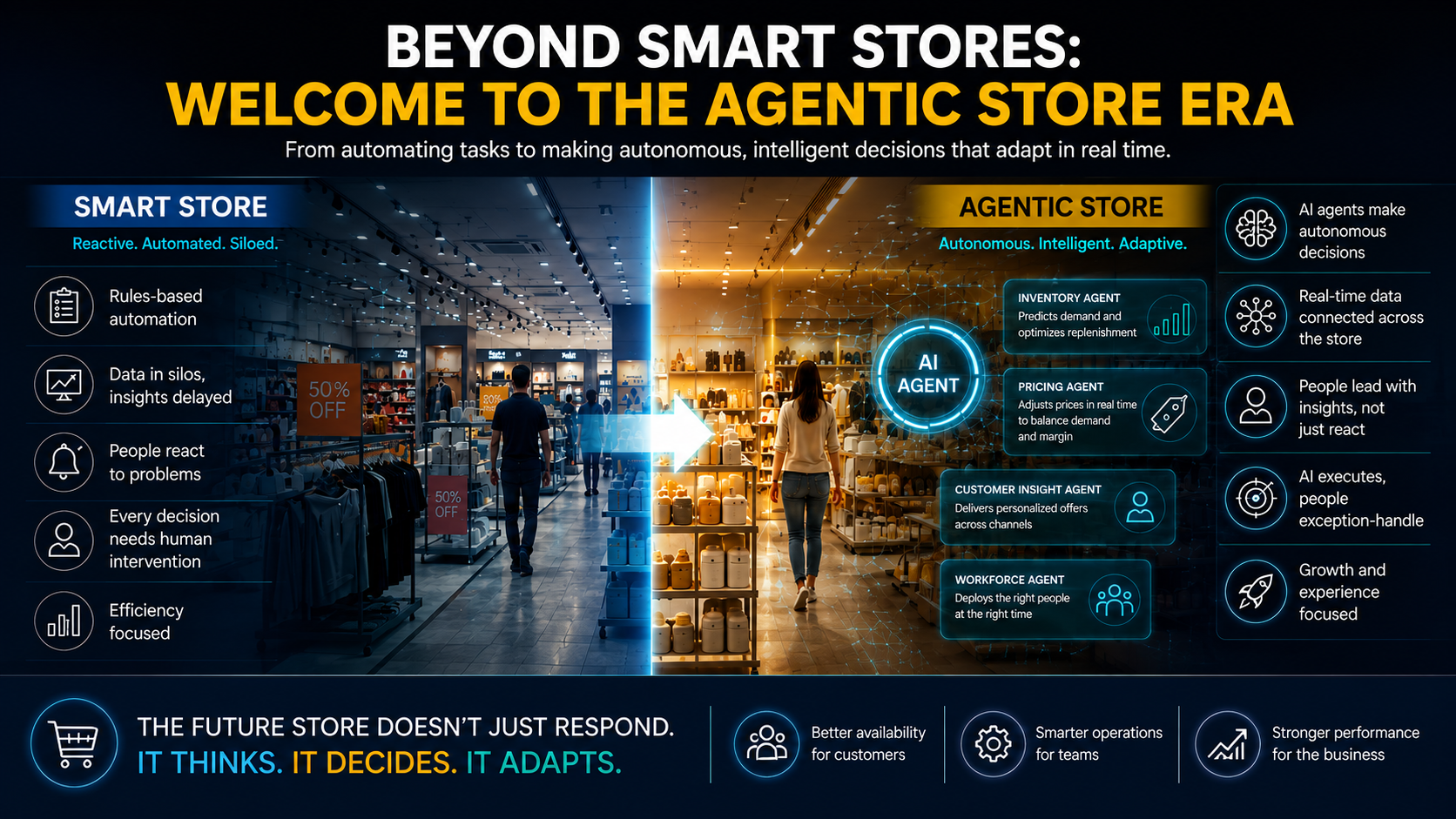
Why the future of physical retail isn't a Smarter Store, but an Agentic Store, where humans, AI agents, and robots work together to run operations and shape the customer experience.
The retail industry is moving from smart stores that collect data to agentic stores where AI plans, decides, and executes operations that used to require human staff. This shift is already scaling. The agentic AI market in retail and e-commerce is estimated at $60.43 billion in 2026, projected to reach $218.37 billion by 2031; a 29.29% CAGR. Broader AI in retail is estimated at $16.54 – $18.4 billion in 2026, forecast to hit $105 – $130 billion by 2033 – 2034.
For the past decade, retailers have spent billions turning physical stores into smart stores: IoT sensors, computer vision, electronic shelf labels (ESLs), autonomous cleaning and shelf-scanning robots, RFID, mobile apps, self-checkout, digital signage, workforce management systems, AI-powered analytics. Today, stores generate more data than ever.
However, when you walk into the back office of most retailers, and store managers are still making hundreds of operational decisions a day:
Which shelves need replenishment?
Should we mark down fresh food?
Do we need another cashier?
Why is this product selling faster than expected?
Which online orders get priority?
Why is this refrigeration unit using more energy today?
Technology has made these decisions better informed. It hasn't made them go away. That's why I think the next stage of physical retail isn't the Smart Store; it's the Agentic Store.
Smart stores help managers make better decisions. Agentic Stores execute the tasks themselves. The difference matters, and its huge. A smart store can tell a manager that shelf availability has dropped below target. An Agentic Store recognizes the issue, checks backroom inventory, creates a replenishment task, adjusts nearby promotions if stock is tight, updates tomorrow's order, and tells the manager what it already did. Instead of generating insights, it coordinates action.
Adoption is moving fast at the board and CIO level:
89% of retailers are using or testing AI; 58% have it in full deployment (NVIDIA, 2026)
43% are piloting agentic AI, another 53% are evaluating it (Salesforce)
76% are actively investing in AI shopping agents; 48% plan to deploy agentic AI in 2026
Retail CIOs are raising AI budgets 36% and generative AI budgets 38% year over year
88% of US business leaders plan to increase AI budgets because of agentic AI (PwC)
Every store gets a digital management team
Mention AI in retail and people picture a chatbot or a shopping assistant. I think the shift is bigger than that. Picture a store with a team of specialized AI agents working around the clock.
A shelf agent monitors on-shelf availability through computer-vision cameras. An inventory agent predicts shortages using weight sensors and the same cameras. A pricing agent balances demand, margin, competition, and inventory, and updates prices and promotions on electronic shelf labels (ESLs).
A workforce agent reallocates associates as foot traffic shifts through the day. A fresh food agent cuts waste by timing markdowns before products expire, updating shelf labels and digital signage around coolers and chillers.
An energy agent trims electricity use without affecting customer comfort. A maintenance agent flags equipment failures before they disrupt operations, drawing on door sensors, vibration sensors, temperature sensors, and other IoT devices.
Each agent on its own solves one problem. Together, they function like a digital leadership team for the store.
The economics back this up. A Forrester Total Economic Impact™ study of Microsoft's retail AI solutions projects 124% – 282% ROI over three years, with $7.7M – $17.6M in net present value for a $5B enterprise. Strategy& (PwC) expects agentic AI to cut customer-service operating costs 30% by 2029; 89% of US retailers already report AI initiatives lifting revenue. Documented results elsewhere: 20% – 30% lower inventory costs, up to 10% higher profit from dynamic pricing, 25% lower last-mile delivery costs, 15% – 25% lower return-processing costs, up to 40% revenue lift from personalization, and 5% – 15% lower labour costs from workforce optimization.
The store starts to think as one system
The real gain from agentic AI isn't one smarter model. It's many agents coordinating.
Take a rainy Saturday afternoon. The system picks up on the weather. Traffic forecasts shift. The workforce agent adjusts staffing. The inventory agent delays selected replenishment. The promotion agent shifts marketing toward delivery and click-and-collect. The pricing agent holds off on promotions that would add congestion in-store. The fresh food agent adjusts production to cut waste. The finance agent updates revenue forecasts.
None of this happens in isolation; it's one coordinated response. I call this the Agentic Store Operating System, or ASOS™.
This isn't about replacing store managers
The question that always comes up: what happens to the store manager?
My answer is close to the opposite of what people assume. Great retailers have never won because managers spend their day printing labels, checking inventory, or shuffling people between checkout lanes. They win because managers coach teams, solve customer problems, build local relationships, and shape the shopping experience.
Agentic stores don't replace that judgment. They remove the operational friction around it; freeing managers to lead, while the technology handles execution and associates handle the experience.
The technology already exists
Retailers don't need a futuristic breakthrough. Most already have the building blocks: electronic shelf labels (ESLs), computer vision, IoT sensors and gateways, robotics, POS systems, order management, loyalty platforms, digital signage, store apps, cloud platforms.
What's missing is a decision layer that lets these systems act together through AI agents. The agentic store won't replace today's smart store; it will orchestrate it. I call this layer the AIOT Control Tower for Agentic Retail Stores™.
The next competitive advantage
Retailers have spent years competing on how digital they are. I think the next advantage comes from how autonomous they are. The winners won't be the ones with the most data; they'll be the ones converting data into thousands of coordinated decisions an hour, across every store.
The question is shifting from "how do we build a smarter store?" to "how do we build a store that keeps optimizing itself?" That's the next chapter of physical retail, and we're only starting to see what it makes possible.
I'm always happy to connect with fellow leaders in retail, tech, and AI to compare notes on where this is heading. If you're working on similar problems or see this differently, reach out; I'd like to hear your take.
Sources:
Microsoft, “Agentic AI is reshaping retail and consumer goods economics,” May 21, 2026. https://www.microsoft.com/en-us/microsoft-cloud/blog/retail-and-consumer-goods/2026/05/21/agentic-ai-is-reshaping-retail-economics/
Strategy& (PwC), “The agentic AI revolution in retail,” March 4, 2026. https://www.strategyand.pwc.com/de/en/industries/consumer-markets/agentic-ai-revolution-retail.html
Deloitte, “Agentic Commerce: AI Shopping Agents Guide 2025,” Feb 24, 2026. https://www.deloitte.com/us/en/industries/consumer/articles/agentic-commerce-ai-shopping-agents-guide.html
eMarketer, “5 key stats on the rise of agentic AI in retail,” Apr 7, 2025. https://www.emarketer.com/content/5-key-stats-on-rise-of-agentic-ai-retail
Kore.ai, “Agentic AI in retail: transforming customer experience and operations,” Dec 28, 2025. https://www.kore.ai/blog/agentic-ai-in-retail
AI Buzz, “AI in Retail: Personalization, Pricing & Agentic Commerce (2026),” Dec 27, 2025. https://aibuzz.blog/ai-in-retail/
Mordor Intelligence, “Agentic AI in Retail and E-commerce Market Size and Share,” July 8, 2026. https://www.mordorintelligence.com/industry-reports/agentic-artificial-intelligence-in-retail-and-ecommerce-market